





Introduction
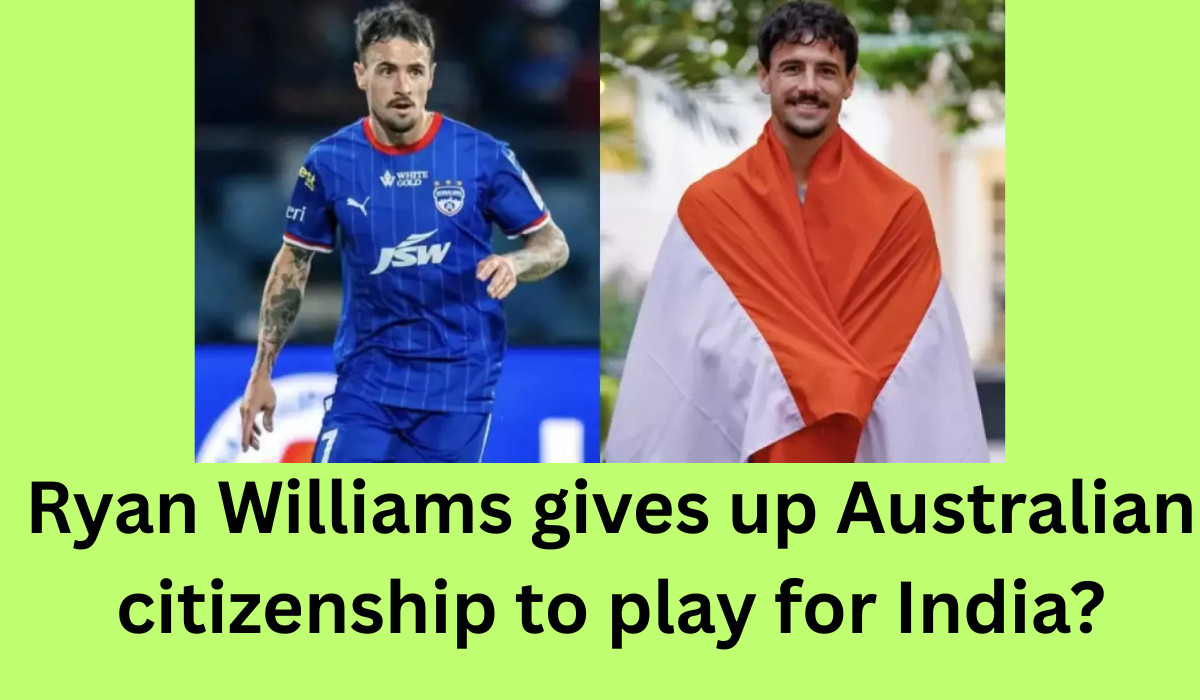
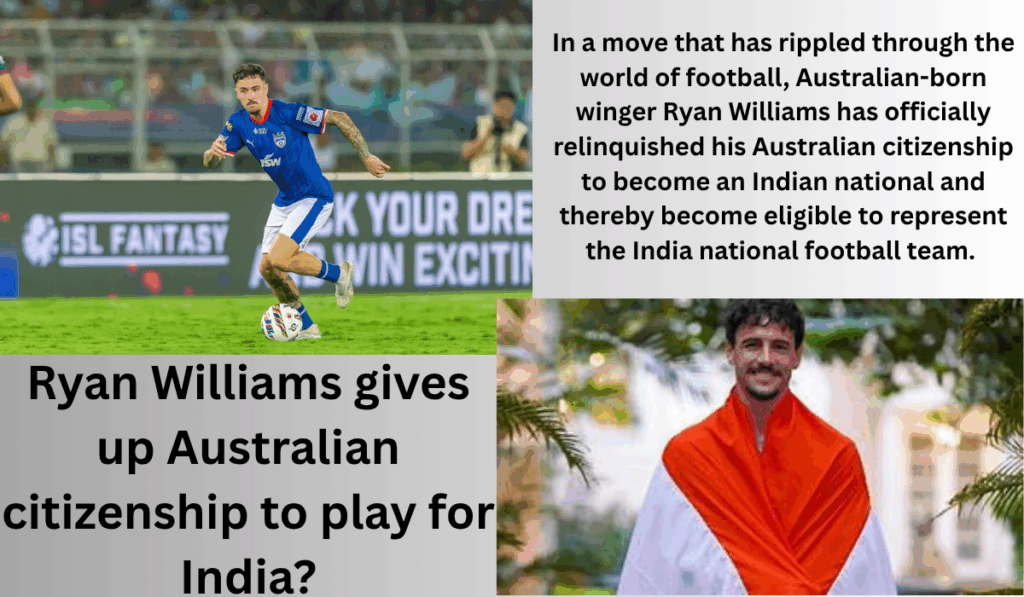
In a move that has rippled through the world of football, Australian-born winger Ryan Williams has officially relinquished his Australian citizenship to become an Indian national and thereby become eligible to represent the India national football team.
This development not only marks a major personal decision for Williams but also signals a potentially significant shift in Indian football’s strategy in integrating diaspora talent.
Background: Who is Ryan Williams?
Born on 28 October 1993 in Subiaco, Perth, Australia, Williams built his career through youth football in Australia and England.
His club timeline: he moved through youth stints at ECU Joondalup (Australia) before heading to Portsmouth (England) in 2010. Over time he played for Fulham, Oxford United, Barnsley, Rotherham United, Portsmouth (again), Perth Glory, and since July 2023, the Indian Super League club Bengaluru FC.
Of particular significance is his heritage: his mother, Audrey, is from an Anglo-Indian family with roots in Mumbai, India; his father is English. This multi-national heritage made him eligible for representation of Australia, England, Wales and India.
He represented Australia at youth levels (U-20, U-23) and made one senior Australia appearance in 2019.
The Decision: Giving up Australian Citizenship
On 7 November 2025, Indian media reported that Williams had renounced his Australian citizenship in order to take up Indian citizenship and to become eligible to play for India.
This step was necessary because India does not permit dual citizenship for foreigners; thus to become an Indian national and play for the Indian team, one must surrender former citizenship.
In a symbolic moment, celebrated India captain Sunil Chhetri playfully “quizzed” Williams before handing him an Indian passport — marking the moment not just as procedural but as an emotional overture to his Indian journey.
Why Was This Decision Made?
There are several layers to Williams’s decision:
1. Heritage & identity
While born and raised in Australia, Williams’s Indian heritage is a strong personal connection. With his mother of Indian origin, and his maternal grandfather having played in the Santosh Trophy for Bombay in the 1950s, Williams has a tangible tie to Indian football.
For many players of Indian origin abroad, the chance to “return” and represent India holds both emotional and symbolic significance.
2. Career opportunity
At 32 years of age, Williams’s prospects for breaking into the Australian national team permanently were limited. Transitioning to India offers a fresh pathway: to become a meaningful international player rather than remaining on the fringes.
Further, as he is already playing for Bengaluru FC in the Indian Super League, the move aligns his club and national commitments geographically and culturally.
3. Strategic import for India
For Indian football, acquiring a player with overseas experience and technical training — in Williams’s case from England and Australia — is a boost. It signals a willingness to integrate diaspora talent and may encourage other Indian-origin athletes abroad to explore similar routes.
Additionally, Williams’s presence could uplift the standard of play, bring leadership, and mentor younger Indian players.
Implications for Indian Football
1. Enhanced talent pool
Indian football has long grappled with a limited pool of internationally experienced players. Opening pathways for players like Williams expands options. Observers had listed him among potential Indian-eligible talents.
2. Policy questions
Williams’s case underscores the citizenship and eligibility hurdle: India’s lack of dual citizenship means players must surrender their prior nationality. That’s a significant sacrifice and may limit how many choose this path.
3. Setting precedent
If Williams successfully integrates into the national team and contributes meaningfully, it could pave the way for more diaspora players. This could enhance competitiveness as India eyes participation in more global tournaments.
4. Balance of team dynamics
As with any import, there is the question of how seamlessly he will integrate into the Indian squad’s culture, tactics, and team chemistry. He will need to adapt both on and off the field.
Challenges & Considerations
1. Citizenship logistics and timing
Even with Williams’s Indian heritage, the process to renounce Australian citizenship and acquire Indian citizenship is complex. FIFA eligibility rules also need to be satisfied. The timing of his first game for India may depend on administrative timelines.
2. Public and fan expectations
There may be heightened expectations from fans (and media) given the novelty of his move and the sacrifice involved. Williams will face pressure to deliver and justify the step.
3. Fitness and form
At 32, Williams is nearing the latter stages of a footballer’s peak. Ensuring fitness, staying injury-free, and adapting to Indian conditions will be key.
4. Integration into Indian football system
The Indian national team system has its own rhythm and demands. Adjusting from club level in the ISL to international fixtures will test Williams’s adaptability.
What This Means for Williams & India’s Upcoming Campaigns
For Williams personally, this decision offers a chance to reinvent his international career, create new legacy chapters, and connect with his Indian roots. If he can adapt rapidly and perform, he could become a leader in the national setup.
For India, Williams’s availability ahead of critical qualifiers (for example Asian Cup or World Cup qualifiers) could add depth on the wing, experience in high-pressure matches, and broaden tactical options. It also signals that India is serious about drawing from the global Indian diaspora.
Conclusion
Ryan Williams’s decision to give up his Australian citizenship to represent India is much more than a change of national jersey. It’s a story of personal heritage, career strategy, national ambition, and footballing evolution. For Indian football, it could mark a turning point in the way diaspora talent is tapped. For Williams, it may well be the beginning of a second — perhaps even more meaningful — international chapter.
As fans and analysts will watch closely, the key question will be: how quickly and effectively does Williams translate his decision into performance on the pitch for India?