






The NFL’s international push entered a new phase in 2025: no longer content with the occasional London fixture, the league scheduled a record number of regular-season games across multiple continents, putting marquee matchups in São Paulo, Berlin, Madrid, Dublin and London. The result is a deliberate, multi-pronged strategy to turn American football into a genuinely global sport — with clear effects on fans, sponsors, broadcasters and local host cities.
Why 2025 matters: scale and strategy
Historically, the NFL’s international outreach started with a few preseason and regular-season games in London and Mexico City. In 2025, the league pushed the accelerator: for the first time the schedule included a week-one game in São Paulo, a landmark regular-season game in Berlin, and the league’s first regular-season game in Spain (Madrid). That expansion—seven international games across five countries—signalled that the NFL now sees international fixtures as core growth levers rather than marketing extras.
The logic is simple: the NFL wants year-round fan engagement, diversified media rights, and stronger sponsorship deals outside the U.S. By staging games in soccer stadiums, using local activations and tailoring broadcasts for different time zones and platforms, the league aims to convert casual local viewers into committed fans and, eventually, to monetize that attention. Reuters and the league itself note that these games are part of a long-term roadmap, not a one-off experiment.
Key 2025 matches and locations — what happened (and why it matters)
- São Paulo, Brazil (Week 1): The Los Angeles Chargers were designated as the team in São Paulo where they faced the Kansas City Chiefs at Corinthians Arena. Staging a Week-1 match in Brazil brought top-tier NFL talent to a massive soccer-loving market and created huge early-season visibility. The choice of São Paulo underscores the league’s appetite to enter South America with premium product placement.
- Berlin, Germany: The Indianapolis Colts were designated as the home team for Germany’s first regular-season game to be played at Berlin’s Olympic Stadium. Germany’s strong sports infrastructure and growing NFL interest (fan clubs, merchandise, youth leagues) make it a logical hub for continental expansion in Europe. Berlin’s historic venues and central location in Europe make it attractive to traveling fans from neighboring countries.
- Madrid, Spain (Santiago Bernabéu): The league’s first regular-season game in Spain — staged at Real Madrid’s Santiago Bernabéu — was another milestone. Playing at one of the world’s most famous soccer stadiums not only maximizes capacity and local buzz but also signals that the NFL courts audiences where soccer culture is strongest.
- London & Dublin: London remains a centerpiece of the international slate with multiple games (Tottenham Hotspur Stadium and Wembley frequently host fixtures). Dublin’s Croke Park hosted the NFL’s debut in Ireland, showing the league’s willingness to diversify its UK/Ireland footprint. These matches sustain an already intense UK fan base and support long-term commercial partnerships.
Together these venues form a deliberate geographic spread: South America (São Paulo), Western and Central Europe (Madrid, London, Berlin, Dublin), and continued UK engagement — allowing the NFL to test markets, measure fan conversion, and grow media/sponsorship revenues in multiple currencies.
Fan impact and ticket demand
International games tend to sell out quickly and draw fans from across the region. For 2025, the NFL reported high demand and international ticket buyers from numerous countries — an indicator that the league’s brand has real pull outside North America. Teams designated as the “home” side for international games often see their global merchandise and social-media following spike, and local tourism benefits from traveling fan groups. Reuters and club-level releases documented strong sales and rising international fan club numbers around the Berlin and São Paulo matches.
The on-the-ground impact is noticeable: local hospitality industries (hotels, tours, restaurants) see uplift before and after games, while cities gain international attention. However, hosting an NFL game requires logistical coordination — field conversions, broadcast infrastructure, security, and community engagement — which is why the league partners closely with local authorities and venue operators.
Broadcasts, digital platforms and a younger audience
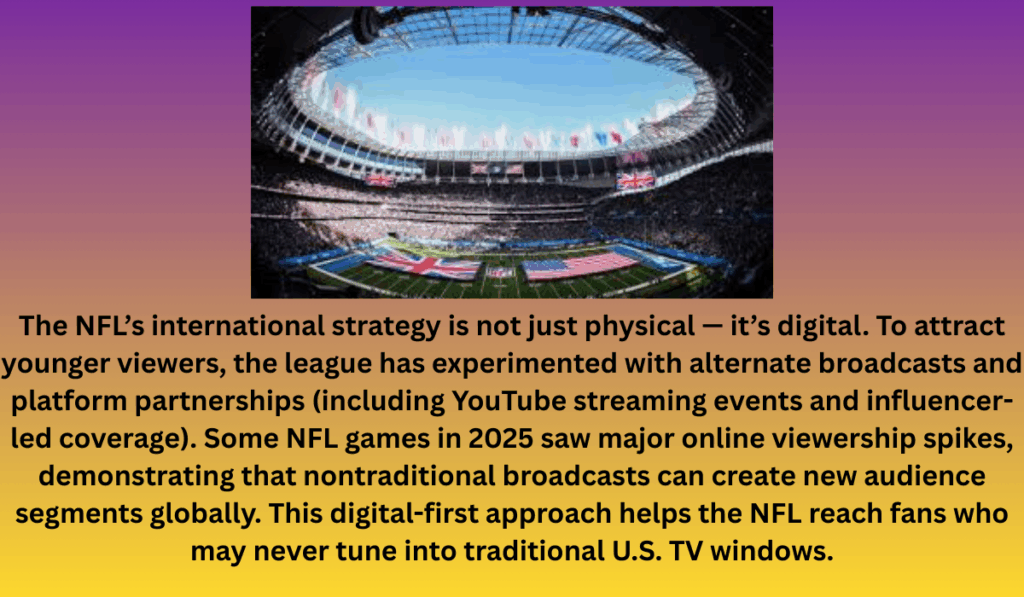
The NFL’s international strategy is not just physical — it’s digital. To attract younger viewers, the league has experimented with alternate broadcasts and platform partnerships (including YouTube streaming events and influencer-led coverage). Some NFL games in 2025 saw major online viewership spikes, demonstrating that nontraditional broadcasts can create new audience segments globally. This digital-first approach helps the NFL reach fans who may never tune into traditional U.S. TV windows.
For broadcasters, international fixtures offer new product bundles: rights holders can sell region-specific ad inventory, localized studio shows and highlight packages. Sponsorships tied to international events (airlines, tech, global beverage brands) tend to command premium rates because of the league’s ability to deliver both local activation and global brand visibility.
Commercial upside:
Playing in new markets unlocks sponsorship opportunities and merchandise sales. Brands that want global footprint see the NFL as an efficient route to reach affluent and engaged audiences. For local markets, partnerships with clubs and schools — e.g., youth flag football programs and coaching clinics — build grassroots interest and help create a future talent pipeline and fan base.
Merchandise sales around international matches spike as fans buy jerseys, caps and team gear. The NFL’s official store and team shops often run special “international edition” collections, which sell well in stadiums and online during the weeks of the games.
Challenges and criticisms
The international push isn’t without challenges. Critics raise questions around:
- Competitive fairness: Teams lose a home game and the typical home-field advantage; travel and schedule disruption can affect performance.
- Local fit: American football must be adapted to local contexts — field markings, rules explanation for new viewers, and broadcast pacing that fits regional viewing habits.
- Saturation risk: Playing too many international games could dilute the special event status and strain team logistics.
- Sustainability: Environmental and economic costs of international travel and large events must be managed carefully.
League executives argue that careful scheduling, designated teams for international duties, and strategic partnerships mitigate many concerns — and the commercial upside justifies the program. Reuters and the NFL’s own operations releases have framed international games as strategic investments rather than short-term promotions.
What this means for local sports culture
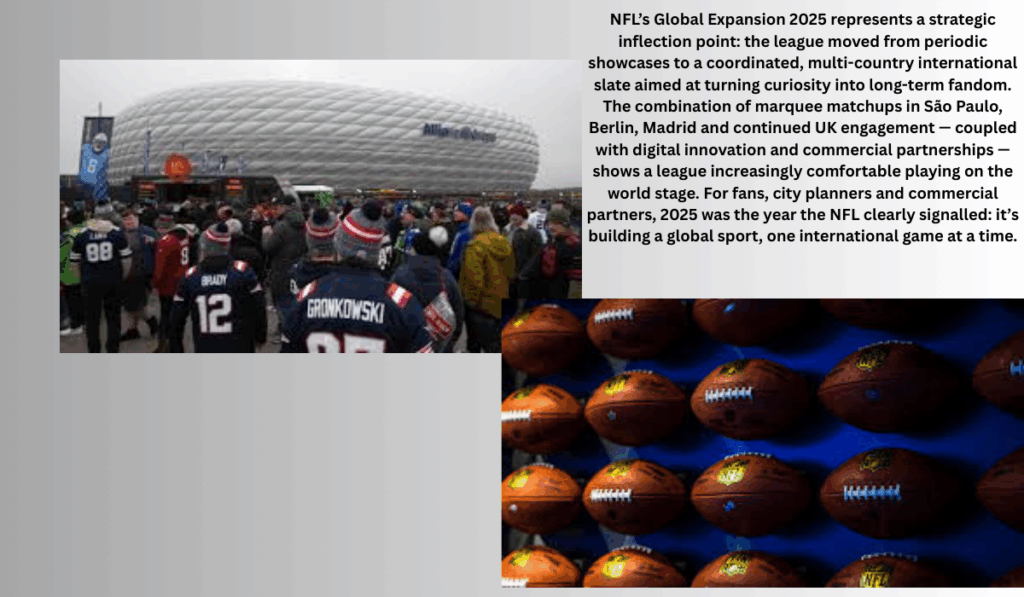
Hosting NFL games accelerates local interest in American football: viewership increases, more youth take up flag football, and local leagues often partner with NFL initiatives. For soccer-centric countries, the NFL positions itself as a complementary spectacle rather than a replacement — a premium event that coexists with local sports calendars.
Cities benefit from global media exposure; stadiums that host NFL games often gain upgrades to meet league standards, leaving a longer-term legacy for other events (concerts, championships) as well.
Where the NFL goes next
The league’s roadmap hints at more global experimentation: more games in new cities, deeper partnerships with European and South American broadcasters, and continued expansion of digital broadcasts and alternate presentation styles. Australia and other markets have been discussed as next steps beyond Europe and South America. As the NFL refines playbooks for international staging — from logistics to localized marketing — expect measured growth rather than a sudden global takeover.
Takeaways for brands, media and creators
If you’re a brand, broadcaster or content creator, 2025’s international slate offers opportunities:
- Brands: Sponsor international activations, create limited-edition merchandise, or support grassroots programs to build local goodwill.
- Broadcasters/streamers: Localized commentary, studio shows timed for regional audiences, and alternate broadcasts can capture new viewers.
- Creators & journalists: Covering the cultural angle (how American football fits into local sportscapes) and human stories (fans, local programs) often outperforms pure game recaps in reach and engagement.
Conclusion
NFL’s Global Expansion 2025 represents a strategic inflection point: the league moved from periodic showcases to a coordinated, multi-country international slate aimed at turning curiosity into long-term fandom. The combination of marquee matchups in São Paulo, Berlin, Madrid and continued UK engagement — coupled with digital innovation and commercial partnerships — shows a league increasingly comfortable playing on the world stage. For fans, city planners and commercial partners, 2025 was the year the NFL clearly signalled: it’s building a global sport, one international game at a time.